


What is SECS/GEM? Why TransSECS?
What is SECS/GEM?
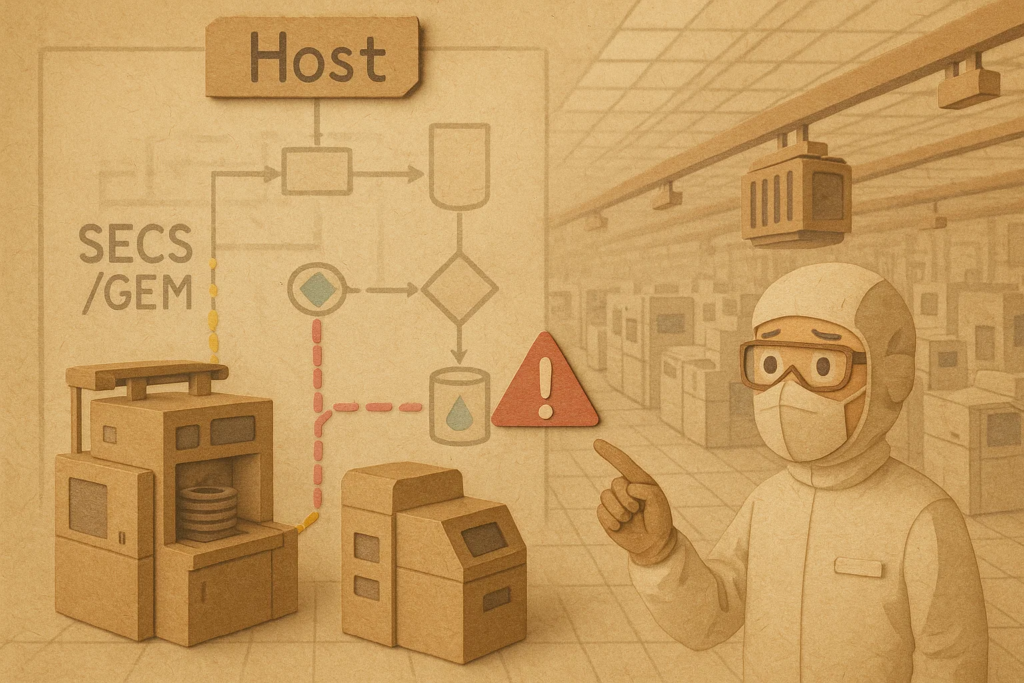
SECS/GEM is a widely adopted communication standard defined by SEMI (Semiconductor Equipment and Materials International) that enables equipment and factory systems to exchange data, commands, and status information. It is the backbone of automation in semiconductor manufacturing and is commonly used for process tools, metrology systems, inspection stations, and test equipment.
SECS/GEM supports a range of core functionality:
- Host-to-tool communication – allows the host system to collect process and status data, issue commands, and track production
- Tool-to-host reporting – enables tools to send alarms, events, and processing updates to the factory system
- Recipe management – supports uploading, downloading, and selecting process programs
- Production control – enables host-directed operation through standard state models and control commands
- Lot and wafer tracking – especially when extended with 300 mm standards
SECS defines the underlying protocol for message exchange. This includes SECS-I (SEMI E4), a serial-based protocol still used by some legacy equipment, and HSMS (SEMI E37), a high-speed Ethernet-based protocol that is now the industry standard. GEM (SEMI E30) defines the equipment model, message structure, and expected behaviors such as alarms, events, collection data, and remote commands.
For advanced automation environments—especially in 300 mm fabs—SECS/GEM is extended through additional standards, including:
- SEMI E39 – Object Services
- SEMI E40 – Processing Management
- SEMI E87 – Carrier Management
- SEMI E88 – Stocker Services
- SEMI E90 – Substrate Tracking
- SEMI E94 – Control Job Management
- SEMI E116 – Equipment Performance Tracking
These extensions add standardized capabilities for managing FOUPs, jobs, wafers, substrates, and performance metrics in highly automated facilities. Many companies are asked to “add SECS/GEM” to a process tool or “connect a tool to the factory host.” Whether you are working on the tool side or the host side, SECS/GEM provides a consistent and reliable framework for integration. However, implementing SECS/GEM from scratch or using a low-level library can be difficult, time-consuming, and risky. This is where TransSECS offers a significant advantage.
Why TransSECS?
TransSECS is a complete, flexible, and proven solution for implementing SECS/GEM on both tool-side and host-side systems. It is designed to help you succeed quickly, with fewer errors and less long-term maintenance.
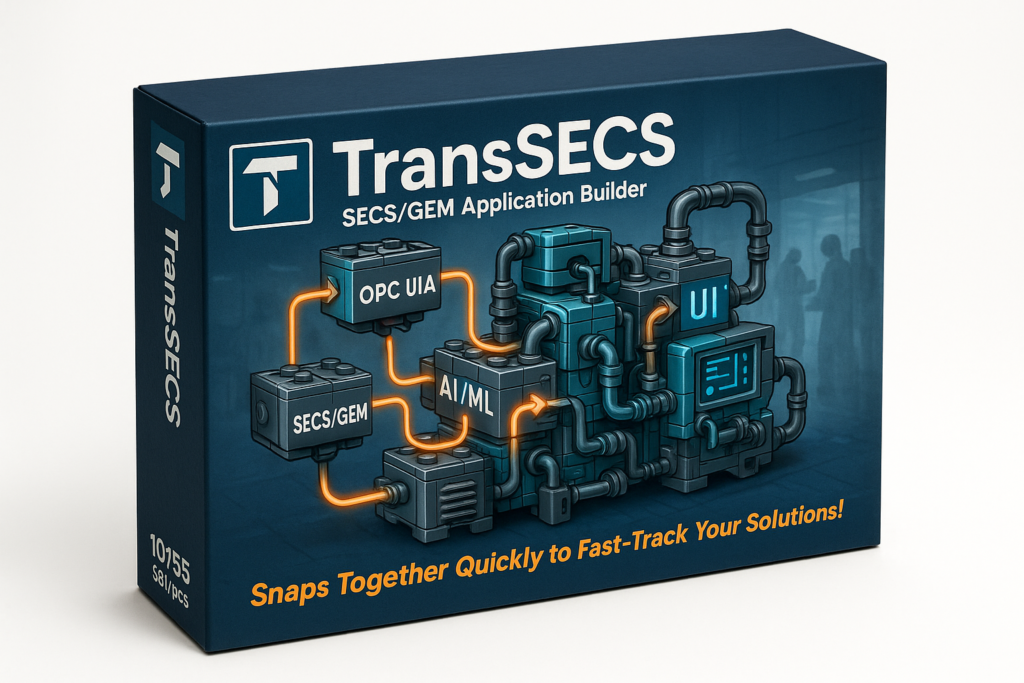
- Prebuilt SECS/GEM protocol support – TransSECS handles all message formatting, state models, and protocol compliance, so you don’t have to write or debug any low-level SECS code.
- Tool and host compatibility – Use TransSECS for either side of the connection: enable a process tool to talk to a factory host, or build a host system that collects data and manages equipment.
- Faster integration and deployment – Built-in templates and tested behavior get you up and running quickly, even with complex GEM configurations or multiple tool types.
- Integrates with your existing system – Connect to controllers and HMI systems via OPC, Modbus, or custom drivers to incorporate TransSECS into new or existing tools.
- Optional operator interface – Add a UI or operator screen when needed—ideal for R&D labs, pilot lines, and small-scale production.
- Scalable and reusable – Reuse implementations across tools and projects; adapt one model for multiple configurations with minimal changes.
- Avoids common pitfalls – Meet fab acceptance requirements and avoid unreliable communications or rework from incomplete implementations.
Why TransSECS?
TransSECS is a complete, flexible, and proven solution for implementing SECS/GEM on both tool-side and host-side systems. It is designed to help you succeed quickly, with fewer errors and less long-term maintenance.

- Tool and host compatibility – Use TransSECS for either side of the connection: enable a process tool to talk to a factory host, or build a host system that collects data and manages equipment.
- Faster integration and deployment – Built-in templates and tested behavior get you up and running quickly, even with complex GEM configurations or multiple tool types.
- Integrates with your existing system – Connect to controllers and HMI systems via OPC, Modbus, or custom drivers to incorporate TransSECS into new or existing tools.
- Optional operator interface – Add a UI or operator screen when needed—ideal for R&D labs, pilot lines, and small-scale production.
- Scalable and reusable – Reuse implementations across tools and projects; adapt one model for multiple configurations with minimal changes.
- Avoids common pitfalls – Meet fab acceptance requirements and avoid unreliable communications or rework from incomplete implementations.
By using TransSECS, you ensure that your implementation meets SEMI standards, avoids integration delays, and delivers the functionality expected by modern fabs and automation teams. Whether you’re an OEM preparing a new tool or a factory automation engineer building a data collection and control system, TransSECS helps you get it done right.
Contact Us
- info@ergotech.com
Interested in SECS/GEM or exploring how TransSECS can accelerate your integration?